
Full Description
What is it?
The NASA Visualization Explorer app was created by NASA to collect advanced space-based research into one iOS application for personal and classroom use.
How to use it
The app is free from the Apple App Store and Google Play. No account or email address is required in order to use the app, which is ready to go as soon as it is installed.
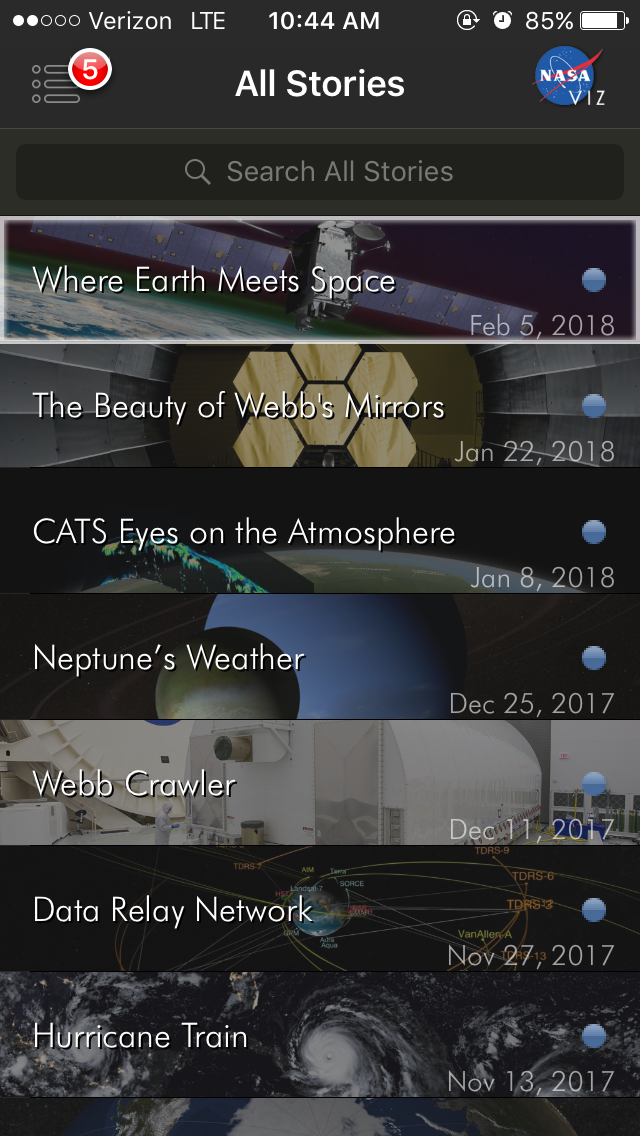
The home page of the app shows all of the stories that are covered on the app (over 500). This allows you to see a broad overview of the kinds of stories that are found on the app, or just to see the latest updates.
However, the app is much more helpful in a classroom setting when these stories can be broken down into their specific topics, which the app allows for. By clicking the menu button in the top left corner, the app allows you to select topics and separates the stories based on subjects such as Earth, Planets and Moons, Sun, and Universe.
Selecting the Universe filter will bring up stories about Galaxy Clusters, Glowing Galactic Clouds, and the Orion Nebula, which would not appear if the subtopic of Sun was selected.
Teacher Usage
The videos on the app can easily be used in class to go accompany a lesson as a visual aid. The stories can easily be used as homework assignments, extra credit, or a source for a research project.
Student Usage
Because the app was not specifically developed to be used in the classroom, it does not have features like activities or assignments. However, the app does supply an ample amount of supplementary teaching materials to accompany the usual science curriculum. The language used in the stories isnt advanced and when scientific terminology is used the terms can be easily understood within the context of the story. NASA Viz helps show the real life applications of the topics that students are learning in the classroom, which is often a struggle with more advanced topics. For example, activities such as summaries, sources for an essay, or simply showing topics in a real world application, including the scientific method or subject specific terms and theories.
Constraints
As stated before, the app does not have features specifically made for classroom use. Some scientific language that requires either teacher instruction or supplemental resources. However, the stories can still be used as supplementary materials or for other activities that improve scientific literacy.
Conclusion
The NASA Viz app, while not having the more classroom friendly features of other apps, provides important supplementary materials for educators to use in their lessons. It provides real world applications of theories being learned by students and allows students with genuine interests to explore topics.